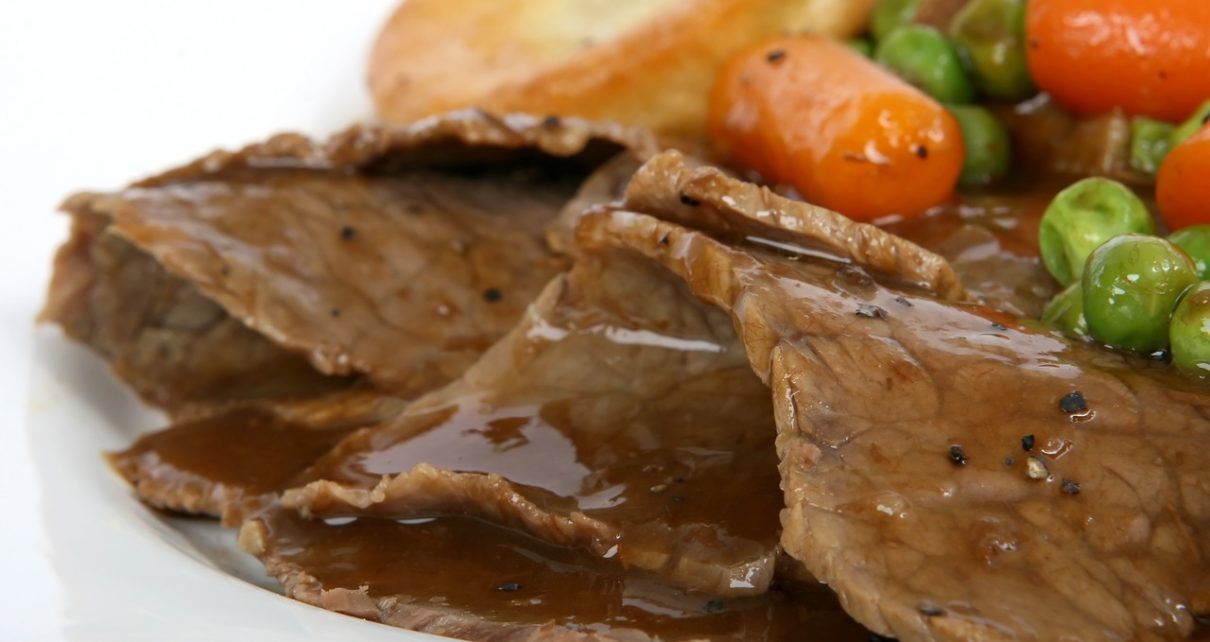
English food, at least the idea of it, has two very different sides in the imagination of the American culinary set. The first is the image of grey, boiled meat. In fact, boiled meat may well be the undeserved poster-boy of the loathed reputation for bland English food. The other side of British food, is perhaps more accurately described as the British flair for the pageant of the meal.
For example, High tea served in a Victorian oak-paneled room surrounded by elaborate fabric, Edwardian porcelain, and a mountain of cakes. Clotted cream sparkles, reflecting in the mirror-polished silver of a tea pot. A picnic on the bank of the river Thames. A white cravatted school boy on his way to supper in the Gothic-vaulted school dining hall.
In any case, the constituents of the meal itself, the food of the United Kingdom, is not nearly as bad as some have made it out to be. With its straightforward flavors, rich puddings and double creams, British food can be quite astounding.
One point that must be made clear is that for hundreds of years, the English upper-classes only dined on French food, and their menus were, and still are, frequented with accents and circumflexes taken from the French language. However, to compare boeuf à la bourguignonne with a Scottish haggis makes no sense at all. This is not to say that there aren’t particular British tastes that are anjoyed by both the aristocracy and the lower classes. There are. One is a love for breakfast, have you heard of the “English Breakfast”? Another is their mutual admiration and taste for meat.
The British butcher wears a white smock and a straw boater. Perhaps his most important job has been to prepare the great roast beefs that anchor the traditional Sunday lunch feast. Roast beef is the pride and jo of the Nation. It is called a “joint of beef,” and is served at lunchtime every Sunday with Yorkshire pudding, roast potatoes, two or more vegetables, a very strong horseradish sauce, beef gravy, and English mustard. The leftover joint could feed the family until Friday (traditionally fish day), recooked in a curry, pie, stew, or fried with cabbage, onions, and potatoes into the onomatopoeic “bubble and squeak.”
Beef farming is a big industry in England, and in Scotland, the Aberdeen Angus is a world-famous beef-producing breed. Dairy cattle are also farmed across the land. England is famous for its different types of creams and English butter is sublime. The British penchant for firm-flavored and tasty cheeses is well-known. Names like Cheshire, Stilton, Double Gloucester, Sage Derby Red Leicester, and of course Cheddar are well-known across the world.
Lamb used to be the second most-widely consumed meat followed by pork, farmed mostly in the counties of Lincilnshire and Wiltshire, at a distant third. However, as Lamb imports from New Zealand have decimated the British Lamb industry, it has become more expensive to farm and is now eaten less regularly.
Game has always been a staple part of the British diet . This reflects both the plentiful richness of the woodlands and rivers and an old aristocratic prejudice against meats that had been butchered. Formal feasts were built around venison, rabbit, and game birds. This preference can still be seen today on the menus of good English restaurants.
Being an island makes fishing easy for the Brits. Fish are a huge part of the English diet. A wide variety of species live in the cold waters of the North Sea including hake, plaice, cod, haddock and sole. Cod being the most popular for the traditional “fish and chips”.
Other species like halibut, mullet, turbot and John Dory are also eaten with their popularity depending on the region. Oily fishes are also abundant. Mackerel, herring and pilchards are consumed by most households. Crustaceans like oyster and lobster are popular. Eel, which is very common, is cooked in a pie with lemon, shallots and parsley, and topped with puff pastry.
The English are justifiably famous for their gardens, and the kitchen garden has long been a source for herbs and vegetables. But much of the flavoring in British cooking comes from further horizons than the garden out the back door. The Brits have long incorporated exotic spices. When the Normans invaded Britain, they arrived with eastern spices like saffron, cinnamon, nutmeg, mace, ginger and pepper.
Sugar also arrived in England at the same time. It was considered a rare and expensive spice. Fruit juices and honey were the only sweetners before the arrival of cane sugars. Some Medieval cookery books still remain that record dishes that use every spice that was available in the kitchen larder, and chefs across Europe made it their mission to create the transformation of raw ingredients into something utterly new with spices.
Throughout northern Europe, elaborate concoctions of mixed meats and offal (almond flour thickeners), spices, raisins, and other dried fruits were the result…and to the credit of the successful chef, there was often no chance that any of the discrete, original flavors could be recognized.
Spices were of course a handy way to mask slightly off meat. There is, in fact, a rule of Victorian etiquette that deems it less than polite to sniff at meat when it is on the fork. The affair with the spices of the East has continued, even to this day, and can be seen preserved in the tastes of the early American colonists, and in the caraway-, ginger-, and mace-laced cakes that grace the tea table. In this vein, the Brits have proven exceptionally good at condiments: strong mustards, horseradish, chutneys, vinegars, marmalades and jams, curries, even Worcestershire sauce.
Now, the cynical may still say it’s a good thing the English have worked so hard at that which covers food. But, if you can, just picture a perfect cup of tea accompanied by scones with a side of clotted cream and homemade strawberry jam. How about slices of perfectly roasted beef with a teaspoon full of strong horseradish? Can you picture a perfectly thin-cut and piece of wild Scottish smoked salmon. You just may find that you have changed your mind at the thought of what the British Isles has brought to their culinary table.
Formal English Dining
Proper Attire for an Englishman in India
“In the eighteenth century a gentleman could go to a formal dinner comfortably dressed in jacket, waistcoat and trousers made of white or buff-coloured cotton. In the early nineteenth century, however, he was expected to arrive for diner in a formal black coat. Then a faintly ridiculous ritual would be enacted, where the host or hostess would invite him to swap his heavy black coat for a lighter one. This he would accept, and he would then go out to the verandah where his bearer would be waiting with the lighter jacket, having been instructed to bring it along in anticipation of this very invitation.
Later in the century things became even more formal, with men having to dress in complete black woolen dinner suits as they did in Britain in the depth of winter. Even white cotton trousers became the exception rather than the rule. As C.P.A. Oman, author of Eastwards, or Realities of Indian Life commented in 1864, some men in Calcutta became used to this and did not seem to feel the heat, but “to see, however, some stout Colonel from the north-west provinces, or a robust individual fresh from home under the ordeal is painfully ridiculous.” Right up until the First World War men would appear at dinner parties in boiled white shirts, white waistcoats, black or white ties, and tail coats or dinner jackets.”
From The Raj at the Table: A Culinary History of the British in India, by David Burton. London: Faber and Faber, 1993. See especially p. 28.
English Food in India
“The tables were covered — groaning beneath the slaughtered hecatombs. It was a feast fit for Homer’s heroes…Soups of all kinds — mulligatawney, and vermicelli, and turtle; huge turkeys and huger hams; barons of beef; saddles of mutton; geese, and all manner of tame fowl; legs of pickled pork, and pease pudding — these were the delicacies that tempted the appetites of Indian epicures. Two or three ultra fashionists, just imported from cold and icy Europe, stared, and turned a little pale as they inhaled the steam arising from the various “savouries” — swallowed a jelly, and a biscuit, and a glass of wine; but the rest of the party addressed themselves valiantly to the work of devastation. They drank beer in huge tumblers, men and women; they ate of the beef, and the mutton, and the pork, and the turkeys and the fowls, and they closed with real Mussulmauni curries….”
A description of a dinner at a ball in the 1830s exerpted from The East India Sketch-book in The Raj at the Table: A Culinary History of the British in India, by David Burton. London: Faber and Faber, 1993.
Dishes From The United Kingdom
Beefsteak, Oyster, and Kidney Pudding
Oysters may seem unlikely in this meat pudding, but their great abundance in the Victorian age and earlier eras inspired cooks to find ways to incorporate them creatively in many different recipes. This steamed pudding combines the meats with mushrooms, onions, tomatoes, and Worcestershire sauce, then wraps the whole in a suet pastry.
Cock-a-Leekie
This Scottish specialty can be classified as a soup or a stew. It combines beef, chicken, leeks, and prunes to unusual and spectacular ends.
Crown Roast Lamb
The crown roast encircles a stuffing of apples, bread crumbs, onion, celery, and lemon.
Eccles Cake
Puff pastry stuffed with a spicy currant filling.
Hasty Pudding
A simple and quick (thus the name) steamed pudding of milk, flour, butter, eggs, and cinnamon.
Irish Stew
An Irish stew always has a common base of lamb, potatoes, and onion. It could contain any number of other ingredients, depending on the cook.
Lamb Cutlets Reform
Lamb cutlets are dredged in bread crumbs, mixed with minced ham, then fried and served under a port sauce with cloves, juniper berries, and thyme.
Likky Pie
Leeks, pork, and cream baked in puff pastry.
Mincemeat
Beef suet is used to bind chopped nuts, apples, spices, brown sugar, and brandy into a filling for pies or cookies.
Mulligatawny Soup
What this soup is depends on who is cooking it. Originally a south Indian dish (the name means pepper water in tamil), it has been adopted and extensively adapted by the British. Mullitgatawny contains chicken or meat or vegetable stock mixed with yogurt or cheese or coconut milk and is seasoned with curry and various other spices. It is sometimes served with a separate bowl of rice.
Syllabub
In the seventeenth century, a milkmaid would send a stream of new, warm milk directly from a cow into a bowl of spiced cider or ale. A light curd would form on top with a lovely whey underneath. This, according to Elizabeth David, was the original syllabub. Today’s syllabub is more solid (its origins can also be traced to the seventeenth century, albeit to the upper classes) and mixes sherry and/or brandy, sugar, lemon, nutmeg, and double cream into a custard-like dessert or an eggnog-like beverage, depending upon the cook.
Trifle
Layers of alcohol-soaked sponge cake alternate with fruit, custard and whipped cream.
Welsh Faggots
Pig’s liver is made into meatballs with onion, beef suet, bread crumbs, and sometimes a chopped apple. Faggots used to be made to use up the odd parts of a pig after it had been slaughtered.
Welsh Rabbit (or Rarebit)
Cheese is grated and melted with milk or ale. Pepper, salt, butter, and mustard are then added. The mix is spread over toast and baked until “the cheese bubbles and becomes brown in appetizing-looking splashes” (Jane Grigson in English Food, London: Penguin, 1977).
Westmoreland Pepper Cake
Fruitcake that gets a distinctive kick from lots of black pepper. Other ingredients include honey, cloves, ginger, and walnuts.
The English Culinery Reputation
“Every country possesses, it seems, the sort of cuisine it is appreciative enough to want. I used to think that the notoriously bad cooking of England was an example to the contrary, and that the English cook the way they do because, through sheer technical deficiency, they had not been able to master the art of cooking. I have discovered to my stupefaction that the English cook that way because that is the way they like it. This leaves nothing to be said, as I suppose the rule that there can be no argument about matters of taste applies to the absence of taste — in the literal sense — as well.”
From The Food of France, by Waverly Root. London: Cassell, 1958.
English Taste In The Morning

Breakfast is the pride of the British Isles. In its fullest glory, it has three or more courses. The first is usually the classic plate of eggs and bacon or ham, grilled up with a tomato.
Second is the fruit or cereal course.
Finally, there is a fish course, like kippers (herring that is split, salted, dried and cold smoked) or kedgeree (an East Indian curried rice and lentil dish, to which the English added flaked smoked fish, hard-boiled eggs and sometimes a cream sauce).
On occasion the fish course will be followed by a final cold course. The Brits don’t shy away from rich meats at breakfast.
Deviled kidneys are made from lamb kidneys marinated in mango chutney, then broiled in a sauce of mustard, lemon, and cayenne pepper.
A mixed grill combines a lamb chop, sausage, liver, and a half a tomato: this hearty plate of food might accompany or follow an egg course! Oat cakes, crumpets, an assortment of toasts, and, of course, jams are always present on the breakfast table.
An English Woman Cooks Curry
“Half the taste and colour of the curry would be destroyed if it were cooked in the very peculiar way that an English woman in England once cooked it.
`This is my rice and curry day,’ she explained to an Indian acquaintance who had accompanied her husband’s regiment to England. `Would you like to stay and see me make it? I believe you Indians do not know how to cook.’
“Her friend expressed her willingness, and many a time after she told the story with amusement.
“The Englishwoman tied a teacupful of rice in a muslin bag, and boiled it in a saucepan of water. She then took a small plateful of cold scraps of meat, one week’s savings, and put it in another saucepan with some curry powder, some butter and stock, and proceeded to boil it.
“When she thought both rice and curry — save the mark — done, she untied the muslin, served the rice in a flat dish, made a hole in the centre of the rice, poured the curry into it and served the unappetising stuff. …”
Quoted from The Wife’s Cookery Book of 1906 in The Raj at the Table: A Culinary History of the British in India, by David Burton. London: Faber and Faber, 1993.
English Pub Fare
At the heart of pub food is the fare of farmers and laborers: cheese, bread, a bit of sausage or bacon — often only the fat — and ale. The ploughman’s lunch is cheddar cheese, bread, pickled onions, and ale. From the bar-man one might also order a Cornish pasty (a savory turnover filled with a mix of meat and potatoes) or eggs wrapped in sausage meat — natural accompaniments for a pint of ale, stout, lager, or hard cider.
English Pies and Puddings
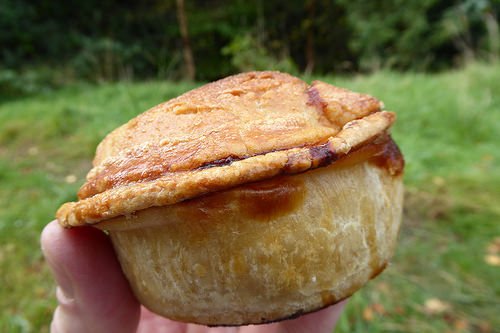
Photo by Bods
Pies and puddings are related phenomena in British culinary history. Originally, both solved the problem of preparing dinners made with less expensive meats. Pies covered a stew or other ingredients with a crust; puddings were made from butcher’s scraps tucked into a sheep’s stomach, then steamed or boiled.
Pies have remained pies, although, in addition to savory pies, there now exist sweet variations, which tend to have two crusts or a bottom crust only. Pie crusts can be made from a short dough or puff pastry. Snacks and bar food (Britain’s fifth food group) are often in pie form: pasties (pronounced with a short “a” like “had”) are filled turnovers.
Over time, however, in a confusing development, pudding has become a more general term for a sweet or savory steamed mixture — as well as a word that describes desserts in general. Black pudding, a stomach stuffed with pig’s blood, is of an ancient variety.
Also typical is plum pudding, a Christmas treat consisting of a steamed cake of beef suet (the white fat around the kidney and loins) and dried and candied fruits flamed with cognac. And, of course, one can’t forget rice pudding, which, along with so many other British nursery foods, has been rediscovered by the late twentieth century American palate.
The Bounty of English Gardens
The English gardener grows cabbage, various tubers such as parsnips, potatoes, and turnips, all of which are culinary staples. Garlic and leeks, too, have found their way into every plot and pot.
Fresh herbs — sage, dill, parsley, and thyme — grow among the flowers. Rosemary and oregano are rarely grown and used considerably less than in their native Mediterranean homes.
Tea sandwiches are flavored by balancing the pungent taste of freshly picked sorrel and watercress against the light flavor of cucumbers.
The garden is also bounded by hedgerows thick with berries. Raspberries, currants, blackberries, juniper berries, cranberries, and elderberries are everywhere, even along the roadsides, and wild strawberries too can often be found nearby. The British use berries to make sauce for duck, jam for tea, trifle, or to enliven liver pâté.
Apples are another fruit with high visibility. Cider, both hard and soft, lies at the base of many recipes sweet and savory.
Grapes don’t grow well in Great Britain, and wine has always been imported. It is rare to find wine in indigenous recipes (though port, brandy, and sherry are common), which sets English foods off sharply from better-known French and Italian cuisines.

How is Irish stew from the UK? Check an atlas or a geography book next time, perhaps? Nice article though!
Hi Joshua, Irish Stew, of course originated in Ireland but it is also very popular in the UK and all over Europe! More here: https://en.wikibooks.org/wiki/Cookbook:Irish_Stew
Northern Ireland is part of the UK… Not to be mistaken for Great Britain
Great point Kathleen, thank you. We will update the article.