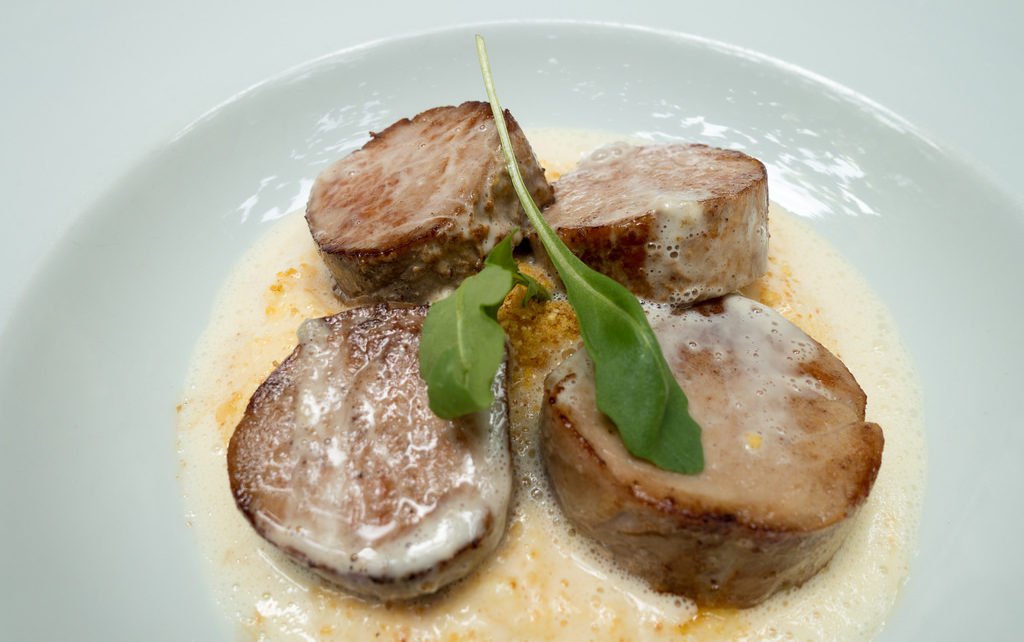
Photo by Kent Wang
Axoa
A specialty of Gascony made with seasoned ground veal, onions, and plenty of sweet and hot red peppers.
Blanquette de veau
This classic French stew is made from veal, mushrooms, and onions. The stew is first simmered in a white stock, then served in a velouté sauce finished with egg yolk and cream.
Civet de lièvre
A hare is cut up and marinated in brandy, red wine, and olive oil. It is then cooked in a roux made from cooked bacon and onion, to which is added an herb bunch (bouquet garni), and garlic. The hare’s blood finishes the sauce.
Coquilles St. Jacques à la Provence
Scallops sautéed with wine, shallot, herbs, and garlic.
Cotriade
This fish soup, often called “Breton Bouillabaisse,” is made with the largest possible variety of fish. This might include eel, mackerel, hake, sardines, John Dory, and Dover sole; shellfish is not used. The soup, which also includes onion, potatoes, and thyme, is served over thick slices of bread.
Foie gras
Foie gras is the oversized liver of a force-fed goose or duck. Goose is preferred. A classic presentation for hot foie gras involves first studding the liver with brandy-soaked truffles, putting a bay leaf on top, wrapping the whole in bacon and then in a pig’s caul — the fatty membrane that lines the abdominal cavity.
This can be baked in a terrine or sealed in a pastry shell, the purpose of which is to absorb the grease released during cooking. Foie gras is also used in pâtés and as garnish, often paired with truffles. The two are characteristic of the cooking of Périgord. In contemporary cuisine, fresh lobes of foie gras are sautéed, often with fruit.
Fonds d’artichauts mirepoix
Mirepoix is a combination of diced carrots, onions, celery and ham cooked in butter. Here they complement artichoke hearts.
Fondue au Fromage
This Swiss dish is also popular in the Alpine regions of France (never mind its cyclical comebacks in the States). It is made by melting a mixture of Gruyère or Comté cheese with white wine until smooth, and flavoring it with kirsch and garlic (often only by rubbing a clove against the inside of the pot before melting the cheese). The fondue is served with chunks of bread for dipping.
Friture
This dish from the western regions of France is made with very fresh, bite-sized river fish that are deep-fried. They are served with vinegar, lemon juice, or tartar sauce as a condiment.
Garbure
Garbure is the name given to many stew-like vegetable soups made throughout France, although the dish is most popular in Gascony. It is made with cabbage, confit of goose and assorted local vegetables and is always served with a thick slice of toasted bread.
Gaudes
This dish is made of a white cornmeal that is very similar to polenta. It can be eaten hot as porridge, but usually it is poured into a mold. Then, when cool, it is sliced and fried with seasonings. Gaudes can be made with savory ingredients, but in Franche-Comté the most popular additions are butter and a sprinkling of sugar.
Lapin à la moutarde
This classic French bistro dish presents rabbit cooked in a grainy mustard sauce with herbs and white wine.
Matefaim
A hearty, thick pancake popular in the Alpine regions of France. It is intended to — as the name says — “tame hunger.”
Matelote
A fish stew made with red or white wine, and, usually only freshwater fish. It is made in many variations throughout France, depending on local tastes and seasonal availabilities.
Pâté
Pâté names a mixture of ground meats and meat fats, game or liver, truffles perhaps, butter, port, Madeira or cognac, herbs and spices. It can be smooth or coarse. If the mixture is served cold, in its baking dish or molded in aspic (a savory jelly), it is called a pâté or a terrine. Pâté en croûte is pâté inside of a pastry crust. A galantine is a bird that has been boned and stuffed with pâté.
Pan Bagnat
A provençal sandwich made by brushing a split loaf of bread with olive oil and then generously filling it with the region’s signature ingredients — olives, onions, anchovies, green peppers, and tomato. The filling is then topped with vinaigrette before closing the sandwich and serving.
Panada
A thick soup or porridge that is popular in Franche-Comté and the Savoy. It is a simple concoction, made with bread, butter, milk and water or stock.
Pissaladière
This provençal relative of the pizza is made by topping a flaky yeast crust with onions, black olives, and anchovies and drizzling the whole with olive oil.
Pistou
A specialty of Italy and Provence, this soup is made with assorted vegetables (usually including green and white beans, tomatoes, onions, and potatoes) and vermicelli noodles. The broth is thickened and flavored by adding a garlic-and-basil paste (essentially, pesto).
Pot-au-Feu
Literally “pot on fire,” this is a dish of meat and vegetables that have been slowly cooked together in water. The rich broth which results is served with croutons as a first course. Then, the meat and vegetables are served as an entrée. The combination of meats and vegetables varies by region. If the meat has bones with marrow, the marrow may be served on toast as another course before the entrée.
Raclette
This Swiss melted-cheese dish is a sort of variation on fondue. To make it, a wheel of cheese (this could be Gruyère, Comté, or the eponymous Raclette) is held to a fire until a layer of it is sufficiently melted that it can be scraped onto a plate. It is traditionally accompanied by boiled potatoes, bread, and a glass of the local white wine.
Ratatouille
This melange of vegetables combines whatever is available in the provençal garden — always including tomatoes, eggplant, bell peppers, zucchini, garlic, and a generous amount of olive oil. The mix is allowed to simmer until done to the cook’s preference, and is then served as a side dish or dip with bread.
Rillons and Rillettes
These two meat dishes are usually made with pork, or, less commonly, with goose, duck or other game. First, the meat is chopped into tiny pieces, seasoned, and cooked in lard. Then, for rillettes, the mixture is pounded into a paste, packed into a jar, and covered with melted lard to preserve it. It is served like pâté. Rillons are served just after the initial cooking.
Ris de veau braisé
These are sweetbreads — the thymus glands of veal (as here), young beef, lamb, or pork — braised in butter.
Rognons de veau flambés
Veal kidneys are cooked in butter and flamed with brandy. After removing the kidneys from the pan, a sauce is made in their juices byadding beef or veal stock, Madeira, cream, mustard butter, and mushrooms.
Sole à la bretonne
A whole sole is spread with a paste of sautéed mixed vegetables and then braised in white-wine based fish broth. It is served with a sauce made of the cooking liquid and a little cream.
Spaetzle
Tiny buttered egg-and-flour dumplings served as a side dish in Alsace and the nearby regions of Germany.
Tripe à la mode de Caen
People either love or hates this this dish, which is created by placing layers of onions and carrots at the base of a casserole dish and then adding one half of a steer’s foot along with its meat. The top layer is tripe, leeks, garlic and herbs. The entire dish is then covered in apple cider and finally a shot of Calvados is poured in (because this Caen is in Normandy, after all). The casserole dish is sealed with a pastry lid. Baked for up to 12 hours and left to cool after cooking, the dish is finally served cold in the terrine.

I enjoy the site.
Some recioes for blanquette de veau would be appreciated.
Merci!