
Italian Cooking
Although Italy is now a cohesive, boot-shaped country, that wasn’t always the case. Once, Italy was little more than a collection of city-states constantly warring with one another. These city-states shared few cultural traditions and no common language. That changed in 1861, when the Italy of today was formed. Even so, the people didn’t establish a common language until the 1940s, and Italians still refer to themselves regionally before calling themselves “Italian.”
The geography and boot-shape of Italy helps to reinforce its regional integrity. A mountain range divides it, creating a series of mountain peaks and deep valleys that are difficult to access. This type of land formation doesn’t lend itself to large cities and metropolises. Instead, Italy is made up of small farming communities, each with its own unique recipes and cooking methods developed over the years.
With the many “Italian” restaurants in America, Americans assume they know typical Italian food, thinking of foods like lasagna and cannoli. However, with their vastly separated communities, Italians don’t have “traditional” Italian foods. Instead, they recognize only regional fare within the separate regions, such as Rome, Tuscany, or Venetia.
There are many differences in foods prepared in different regions of Italy; however, there are also some similarities. All Italian food is considered to be innovative and the recipes flexible. This means no two dishes will be the same, even if the chefs use the same recipes; so dishes considered classically Italian will vary each time they are prepared, sometimes even when prepared by the same chef.
Despite its flexibility and non-adherence to traditional cooking techniques, Italian fare has still had a huge impact on both cooking and eating throughout all of Europe, especially in France. Italians in Venice were also the first people in Europe to use forks, while people in Florence were the first to worry about the order in which dishes were served and which courses should be paired together and with which beverages. Furthermore, Italians were also the first people to bring sweets, fruit pastes, and preserves into Western culture.
An Italian Meal
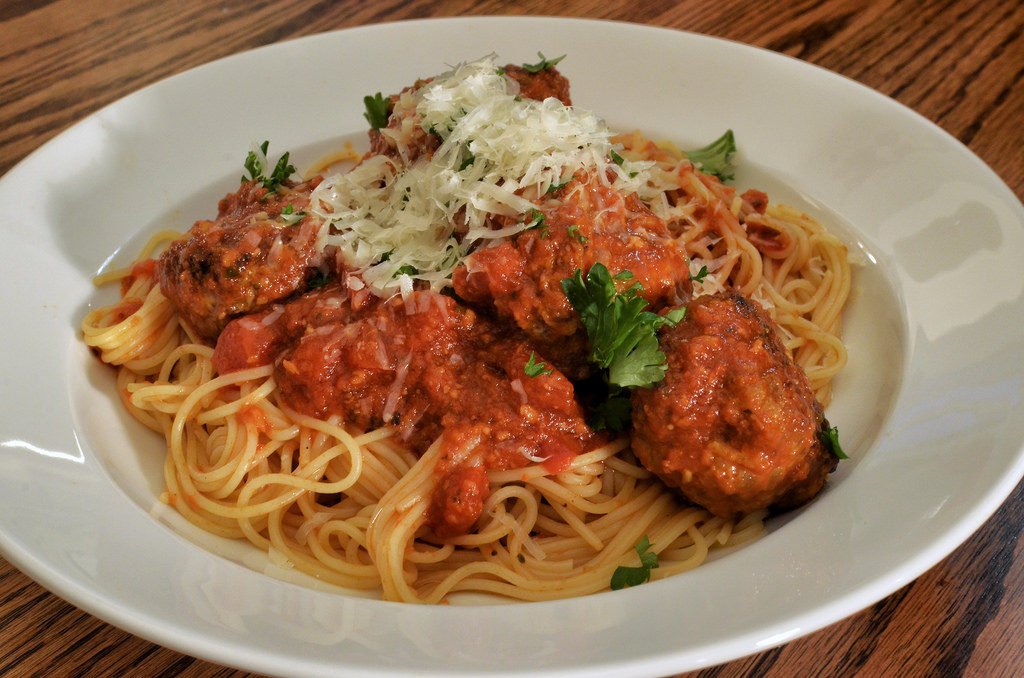
Photo by jeffreyw
Most Italian chefs put heavy emphasis on variation, theme and a quanto basto – “as much as you need” – attitude while cooking, and the meals reflect that. Most Italians serve a series of small dishes and courses that revolve around a central theme. The exception to this is the traditional Italian dish ossobuco e risotto, Milanese style, which is served as one main dish.
A typical meal mixes contrasting dishes, allowing the diner to enjoy both crisp and soft, complex and simple, and mild and flavorful foods. Oftentimes antipasti are sometimes served to help whet the appetite before a full meal. This antipasto could come in the form of prosciutto di Parma with melon, vegetables dressed with olive oil, or Tuscan crostini covered with liver spread.
After an antipasto, the first dish is served. Italians usually refer to this dish as the primi, which means “first,” or minestra, which is simply soup. A traditional primi can be a soup, a risotto, or some type of pasta with sauce or broth. Despite which dish is served first, it’s always served in a bowl rather than a plate and comes before the meat dish. After the first course comes the second, or secondi.
However, in Italian culture, the course system is a way for the diner to enjoy the first course and then decide what the best choice would be for the second course as a follow-up. The second course is always the meat – beef, pork, or poultry – course. Vegetables are also usually served as a side.
After the secondi has been finished and the dishes cleared away, a salad is served. The meal usually ends with a dessert of some kind. Italians refer to this as a dolci. Another, slightly healthier, option for dessert is fresh fruit.
Take the following as an example of a traditional, full-course Italian meal created by Marcella Hazan.: The theme is fish. The antipasto for this meal is a dish of boiled shrimp, seasoned with olive oil, parsley, and lemon juice, served warm.
After that comes the primi, in this case, a squid and clam risotto to add some peppery flair. The secondi dish is a turbot seasoned with garlic and cooked with potatoes.
The salad for this meal is radicchio and field greens; the slightly bitter taste of the radicchio serves as a palate cleanser before the dessert, which is a simple dish of fresh fruit that has been sliced and is served in wine.
For more on classic Italian cooking, dip into Essentials of Classic Italian Cooking, by Marcella Hazan. (Knopf: 1993) See esp. pp.649-665.
Some Italian Dishes

Photo by StoryTravelers
A list of Italian dishes that make up an important part of the Italian cuisine repertoire.
Antipasti
Fiori Fritti
Saffron-colored zucchini blossoms are served deep-fried, sometimes filled with ricotta and herbs before frying.
Frittata
A round omelet, a frittata is thicker than its French cousin and often has the ingredients — such as artichokes or asparagus — mixed into the eggs instead of nestled between folded halves. Frittatas are often sliced and served cold as an appetizer.
Panzanella
This is a Florentine bread salad, in which stale Tuscan bread is soaked in water with tomatoes and onions. The bread is then wrung out, and tossed with tomatoes, onion, basil, and olive oil.
Polenta Fritta
Day-old polenta is a wonderful antipasto when sliced, deep-fried, and salted.
Suppli al Telefona
This is a deep-fried rice croquette with a mozzarella filling. When you bite into it, the hot cheese stretching down from your chin resembles the cord of a telephone.
Primi Piatti
Pappa al Pomodoro
This lovely and simple bread and tomato soup works only when the bread is excellent, the tomatoes red and ripe, and the olive oil top-notch. These elements carry the soup’s flavor, aided only by a bit of chicken stock, garlic, and basil.
Ravioli Nudi di Pesce
These “naked fish” ravioli are essentially a filling without a pasta pillow-case to surround them. Raw fish is ground and bound with egg yolks and flour. The mixture is rolled into balls that are then poached.
Ribollita
Ribollita means, literally, reboiled. It is a Florentine soup made by enriching and reheating yesterday’s minestrone with good peasant bread.
Risotto alla Milanese
Risotto, the Italian rice specialty, is prepared by mixing hot stock into arborio rice(short, fat, Italian-grown rice) that has been sautéed in butter. Risottos can take any form, some soupy, others rich and solid. When tinged with saffron, Risotto alla Milanese wears one of its most famous and ancient guises.
Risotto con le Zucca
This risotto builds from a base of pumpkin (an Italian favorite) that has been sautéed with onions and simmered in chicken stock.
Timballo di Piccioni
A timballo is a dish prepared in a pastry shell. This one combines squab and macaroni in a balsamella sauce (Italian béchamel). The whole is cooked in a pre-baked pastry shell.
Tortelli al Coniglio
This is circular or sqaure twists of pasta stuffed with potatoes and Parmesan cheese. The light sauce is made from rabbit stock, rabbit liver, pancetta, wine, and vegetables.
Trippa alla Fiorentina
Tripe that has been cut into long, thin strips is boiled until tender, then stirred into a light stew of vegetables, wine, and herbs — parmesan tops the dish.
Stracciatella
Meaning “little rags,” this famous soup of the Roman region is made by combining Parmesan, raw egg and lemon batter with hot broth by stirring it gently into the broth. Similar to the Chinese dish, hot and sour soup, which is sometimes called egg-drop soup, the egg divides into strings as it poaches.
Secondi Piatti
Arista
A loin of pork is split and filled with a mixture of black pepper, garlic, and rosemary. It is then tied back together and roasted.
Bollito Misto
An ancient dish, famous in Modena and surrounding areas, is, as named, mixed boiled meats, including chicken, beef tongue, and pig’s foot. The meat broth is rich and the meat super-tender.
Pollo alla Diavolo
A dish shared by Rome and Tuscany to the north. A whole chicken is flattened, rubbed with olive oil, garlic, lemon, and perhaps some rosemary, and grilled over hot coals.
Fritto Misto
A relative of bollito misto, fritto misto is a collection of sweetbreads, vegetables, cheeses, chicken, and other croquettes breaded and deep-fried. It is served in a great mound.
Ossobuco
Ossobuco’s literal translation, “mouth, or hole, in the bone,” aptly describes this dish. Veal shanks are halved to reveal the inner marrow, then braised with pancetta (Italian bacon cured with spices, not smoked), wine, tomatoes, carrots, onions, and celery. Special spoons are used to scoop out the marrow.
Pastello di Pesce
This recipe predates the return to culinary simplicity that marks the Renaissance — a fact that may be obvious from the many spices used to flavor the fish, including cinnamon, cloves, nutmeg, ginger, saffron, and cayenne pepper. The fish is rubbed with these spices and baked in pastry.
Pollo alla Cacciatora
This is a pan-Italian dish, a rustic preparation of fowl — traditionally game — that has migrated to all other meats. It is a stew full of aromatic herbs, garlic, wine and olive oil.
Saltimbocca
A Roman specialty, a breaded veal cutlet with sage is fried so it “jumps into your mouth.”
Dolci
Castagnaccio
Medieval peasant cooking often relied on nuts to make flours and to thicken sauces — this cake is made from chestnut flour, pignoli nuts, and raisins.
Timballo di Pere
A pastry shell of sweet dough is baked then layered with whole pears poached in wine and whipped cream. Then, the dish is covered with a pastry lid.
Zabaione(Zabaglione)
This delicate, all-purpose dessert combines egg yolks, sugar, and Marsala over simmering water until they thicken into a frothy custard. It is known in France as sabayon.
https://www.youtube.com/watch?v=RPvxtu2pIpY
